Vireon Biologics

Science & Platforms

Structural biology built for clinical translation.

Our integrated R&D engine links computational Fc-Lock™ interface design directly to continuous ATF perfusion and multi-attribute mass spectrometry—eliminating developability failure before IND filing.

Platform Benchmarks (Illustrative)

Cognate Heterodimer Purity
>98.5%
Perfusion Productivity
11.2 g/L
High-Conc. Solubility
>150 mg/mL
01Core Technology Pillar

Vireon Fc-Lock™ Antibody Engineering

Structural precision across asymmetric bispecifics and extended half-life scaffolds.

Electrostatic and steric CH3 interface engineering achieves >98.5% cognate heterodimer pairing without common-light-chain compromises, paired with modular FcRn half-life extension and tailored effector silencing.

Conventional bispecific antibodies often suffer from heavy-light chain mispairing, thermal instability, and rapid serum clearance. Our Fc-Lock™ architecture combines computational interface modeling with high-throughput developability screening so every candidate enters preclinical development with monoclonal-like stability and high solubility (>150 mg/mL).

Heterodimer Purity
>98.5%
Serum Half-Life Lift
3.4×
Thermal Stability (Tm1)
≥68 °C
Translucent frosted quartz and glass molecular sculpture illuminated on an ice-mint backdrop

Technical Specifications · 01

  • Asymmetric 1+1 and 2+1 T-cell engager formats
  • pH-dependent FcRn affinity tuning for quarterly dosing
  • Complete FcγR & C1q silencing for cytokine-fusion safety
  • Automated aggregation and viscosity de-risking at 180 mg/mL
02Core Technology Pillar

High-Titer Perfusion Bioprocess

Continuous single-use ATF perfusion built for shear-sensitive complex biologics.

Proprietary intensified CHO cell lines operating under closed alternating tangential flow (ATF) perfusion achieve consistent 11.2 g/L volumetric productivity while maintaining tight glycoform control.

Complex bispecifics and enzyme fusions degrade during long fed-batch residence times. By pairing real-time Raman spectroscopy with closed continuous perfusion, Vireon reduces product residence time to under 24 hours—cutting fragmentation by 72% while shrinking cleanroom footprint by half.

Volumetric Productivity
11.2 g/L
Residence Time
<24 hrs
Downstream Recovery
86%
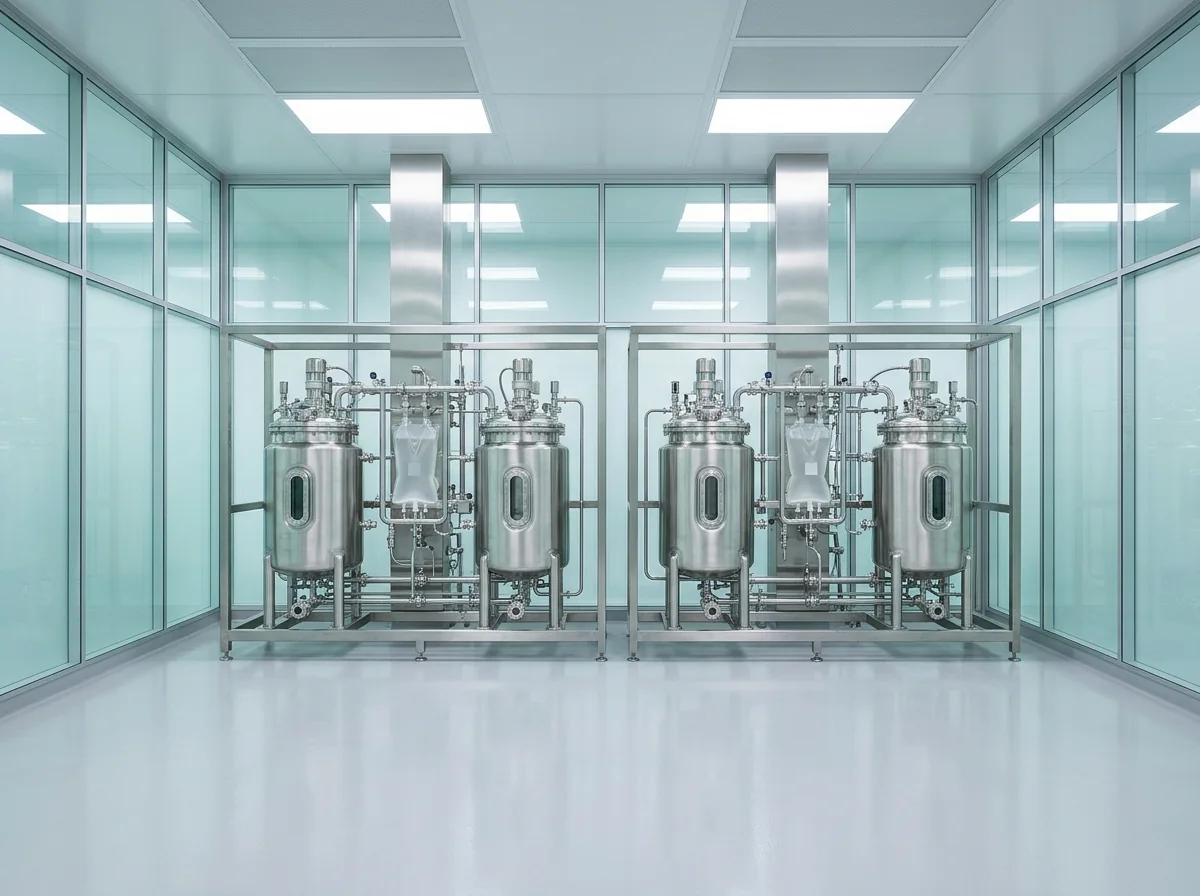
Gleaming stainless steel and glass cGMP cleanroom bioreactors inside a clinical manufacturing suite

Technical Specifications · 02

  • Clonal CHO-V9 master cell banks with serum-free chemically defined media
  • Inline Raman PAT for closed-loop glucose, lactate, and titer telemetry
  • Continuous multi-column Protein A capture and viral inactivation
  • Direct linear scaling from 2L AMBR® models to 2,000L commercial trains
03Core Technology Pillar

Multi-Attribute Analytical Characterization

Orthogonal LC-MS/MS quality-by-design from discovery clone selection to commercial release.

Every clinical lot undergoes high-resolution intact mass spectrometry, glycan profiling, capillary isoelectric focusing, and cell-based potency verification under a unified global comparability protocol.

Regulators expect unambiguous structural comparability when transitioning from clinical supply to commercial launch. Our harmonized analytical suites in Basel, Boston, and Songdo share identical reference standards, automated multi-attribute method (MAM) workflows, and electronic audit trails aligned with ICH Q2(R2) and Q14 guidelines.

Critical Quality Attributes
48+ MAM
Release Turnaround
14 Days
Site Method Equivalence
3/3 Sites

Technical Specifications · 03

  • LC-MS/MS peptide mapping & deamidation/oxidation quantification
  • 2-AB UPLC & HILIC sialylation and bis-M6P glycoform release
  • SPR & BLI kinetic affinity profiling against FcRn and target antigens
  • ICH Q5C accelerated and real-time commercial stability programs

Technical Briefing

Scientific & platform FAQ.

For detailed non-confidential technical data packages or Fc-Lock™ licensing terms, contact our scientific partnering team.

Request Platform Whitepaper

Fc-Lock™ pairs complementary steric and electrostatic mutations across the CH3 heavy-chain interface alongside engineered CH1–CL disulfide positioning. In standard single-cell CHO expression, this drives >98.5% cognate heterodimer assembly before downstream polishing, eliminating the need for separate fermentation trains.